

Death Toll Hits 212 as Sri Lanka Battles Cyclone Ditwah’s Devastation
KELANIYA, Nov 30 (Foxton News) — Sri Lanka continues to grapple with the catastrophic aftermath of Cyclone Ditwah, as the official death toll rose to 212 on Sunday, with an additional 218 people still missing, according to emergency officials. Rescue teams have now entered their fourth straight day of operations while the country faces one of its most damaging natural disasters in recent years.
The cyclone unleashed relentless rainfall across the island nation starting Thursday, triggering widespread flooding, overflowing major rivers, and causing multiple landslides in the mountains of central Sri Lanka. As authorities race against time, the immense scale of the destruction has left entire towns submerged, tens of thousands displaced, and nearly one million people affected nationwide.
Nearly One Million People Affected as Monsoon Flooding Engulfs Communities
Sri Lanka’s Disaster Management Centre (DMC) reported that close to 200,000 people have been forced into 1,275 temporary shelters after their homes were inundated or swept away by flash floods. What began as heavy showers quickly escalated into record-breaking rainfall that battered southern and central districts, overwhelming drainage systems and pushing major water bodies to the brink.
Many areas saw riverbanks burst, sending torrents through villages and farmlands. Entire neighborhoods were swallowed by rising waters in a matter of hours. In some regions, residents climbed to rooftops or upper floors as floodwaters surged through residential streets, carrying debris and cutting off road access.
The hardest-hit areas include the central highlands—where saturated hillsides gave way, burying homes under cascading mud—as well as coastal and suburban zones around Colombo, which faced some of the most intense flooding in recent memory.
Military Mobilized as 24,000 Personnel Carry Out Rescue Missions
Sri Lanka’s military has been deployed at full force as the crisis deepens. More than 24,000 personnel from the army, police, navy, and air force have been dispatched to assist rescue missions, deliver relief supplies, and help evacuate trapped families. Many of these operations involve navigating through dangerous waters, collapsed infrastructure, and unstable terrain.
Using boats, improvised rafts, and helicopters, teams are working around the clock to reach isolated communities. In places where bridges have collapsed or roads are submerged, airlifting remains the only viable method of evacuation. Military spokespersons have described the situation as “one of the most complex large-scale rescue efforts in a decade,” requiring coordination across multiple agencies.
Dam Breach at Mavil Aru Reservoir Triggers Emergency Airlifts
One of the most alarming developments occurred when waters breached the dam of the Mavil Aru Reservoir in the eastern region. The surge of water threatened downstream villages, prompting an urgent response from the air force.
More than 120 people were rescued by helicopter after rising waters cut off all ground access. Many were lifted from rooftops or patches of elevated land where they had taken refuge after their homes were engulfed.
Following the breach, the military evacuated an additional 2,000 residents to higher ground as a precaution, fearing further structural damage to the reservoir. Authorities say that although the breach has stabilized, inspections are ongoing to determine whether more evacuations may be necessary.
Colombo and Surrounding Areas Among the Worst Hit
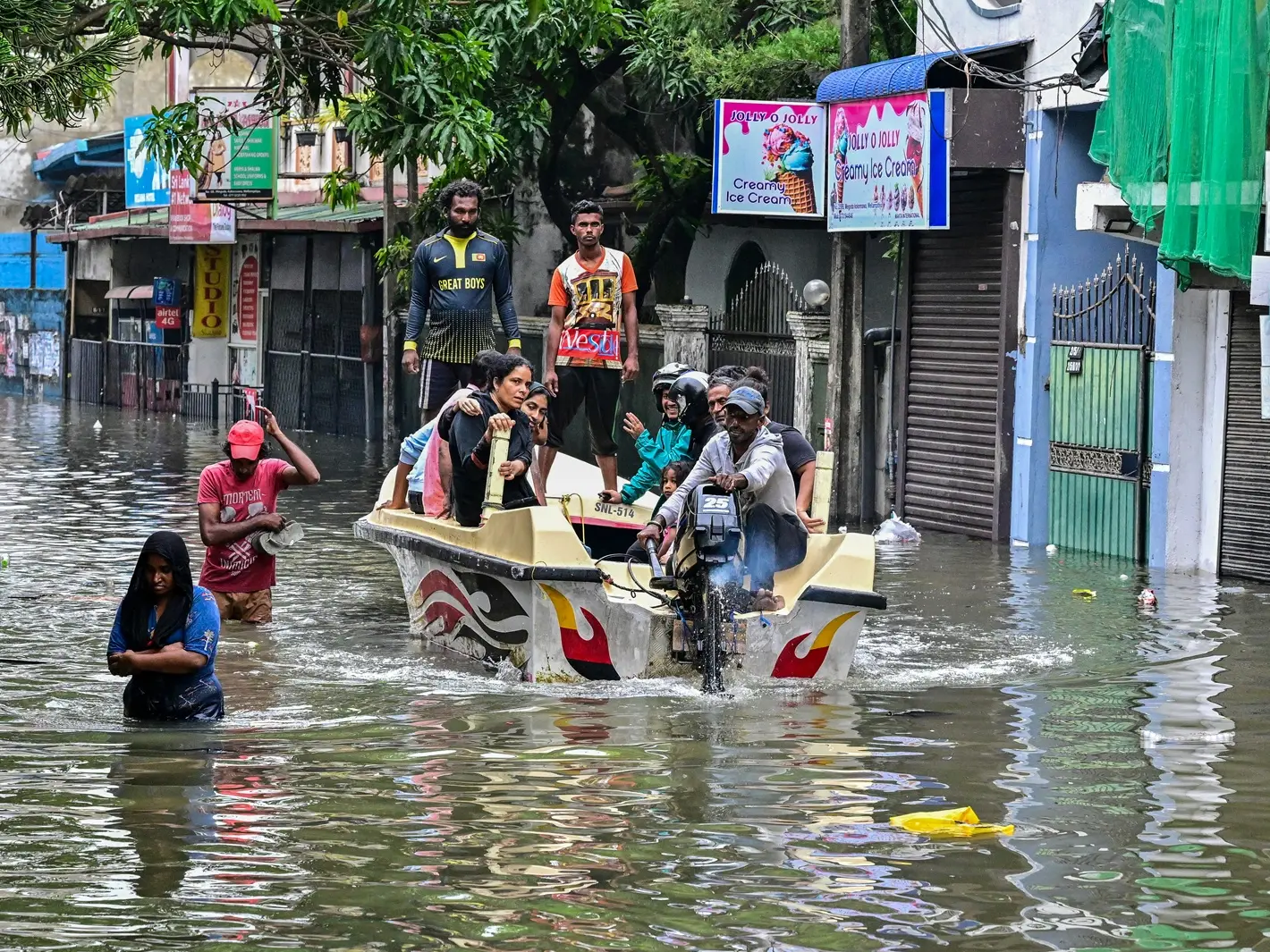
Sri Lanka’s commercial capital, Colombo, typically considered a safe zone during extreme weather, has been severely impacted. Low-lying neighborhoods transformed into waterlogged zones, with streets turning into rivers and ground floors swallowed by muddy floodwaters.
The suburb of Kelaniya, in particular, has endured substantial damage. Entire blocks are submerged, leaving dozens of families stranded inside their homes. The region also hosts thousands of evacuees who now rely heavily on state-provided meals and community donations.
Although government agencies and volunteer groups have been distributing food parcels, cooked meals, and bottled water, many residents say assistance has been inconsistent or delayed due to travel restrictions and dangerous flood patterns.
Voices From the Disaster: Families Describe Their Ordeal
Among the affected residents in Kelaniya is Sunethra Priyadarshani, a 37-year-old mother who recounted her family’s harrowing experience to Reuters.
For two days, Sunethra and her sister remained stranded on the upper floor of their home with four young children. As the water level rose, the family found themselves trapped with dwindling supplies.
“We slowly ran out of food,” she said. “Last night, we only had biscuits and water left for the children.”
The family was finally rescued when a boat delivering meals to the neighborhood spotted them from a distance. The rescuers provided lunch before transporting them to safety.
“We only have the clothes we are wearing,” Sunethra explained. “We’ll stay with my aunt for now, but we desperately need help. Everything we had was taken by the water.”
Stories like Sunethra’s have become increasingly common as residents confront the widespread losses brought on by Cyclone Ditwah.
Shelters Strained as More Than 17,000 People Wait for Waters to Recede
Across Colombo District alone, over 17,000 individuals are currently living in emergency shelters—schools, temples, community halls, and makeshift camps hastily converted into safe zones. Supplies such as bedding, clean water, and hygiene essentials remain in high demand.
Many shelters report overcrowding, with entire families sharing single mats or sleeping in close quarters. Health officials warn that prolonged displacement raises the risk of waterborne diseases, respiratory infections, and sanitation challenges.
Volunteer groups, religious organizations, and local charities have stepped in to augment government relief efforts. Still, damaged infrastructure and relentless rainfall have slowed the distribution of food, medicine, and emergency supplies to some of the hardest-hit zones.
Record Rains Trigger Landslides Across Central Highlands
The central highlands—known for steep terrain and tea plantations—experienced some of the cyclone’s most devastating consequences. Prolonged rainfall saturated the slopes, increasing instability and triggering landslides that buried homes, roads, and agricultural fields.
Several villages were cut off for days as mudslides blocked access routes and destroyed electricity lines. Heavy machinery is being sent to clear debris, but ongoing rain continues to pose a risk of further slope failures.
Geologists warn that the soil remains dangerously unstable, and residents have been urged to avoid returning to homes built on or near vulnerable hillsides until assessments are complete.
Irrigation Department Predicts Slow Recession of Floodwaters
The Irrigation Department forecasts that floodwaters will begin gradually receding over the next three days, assuming weather patterns remain steady. As Cyclone Ditwah shifts northwest toward southern India, rainfall is expected to ease temporarily.
However, officials caution that swollen rivers and oversaturated soil mean improvements will be slow. They also warn that any additional rainfall could prolong the crisis.
Once waters subside, attention will turn to assessing agricultural damage, infrastructure losses, and long-term displacement—tasks that could take months to fully understand.
Government Faces Rising Pressure Over Relief Coordination
The scale of the disaster has intensified scrutiny of the government’s emergency preparedness. Many displaced residents have expressed frustration about delays in receiving aid, with some shelters reporting shortages of essentials such as baby formula, drinking water, and dry rations.
Authorities argue that logistically complex conditions—such as washed-out roads, landslides, and damaged bridges—have made it extremely difficult to transport supplies quickly.
Still, public criticism is mounting, especially in heavily affected urban areas like Colombo, where expectations for rapid response are higher.
Government spokespersons have emphasized that all available resources are being deployed and that international assistance may be sought if conditions worsen.
A Nation in Mourning, Yet Determined to Rebuild
Cyclone Ditwah has left Sri Lanka confronting one of the toughest humanitarian challenges in recent years. With hundreds dead or missing, thousands displaced, and livelihoods swept away, the emotional and economic toll continues to deepen.
Despite the devastation, the response from civilians, volunteers, and local organizations has demonstrated resilience and unity. Flooded neighborhoods have seen residents helping neighbors into boats, sharing food, and cooperating with rescue crews.
As the nation waits for waters to recede and searches the rubble for the missing, Sri Lanka faces a long road ahead. But with rescue teams still working tirelessly and communities rallying to support one another, many hope the rebuilding process will mark not just recovery—but renewal.
