
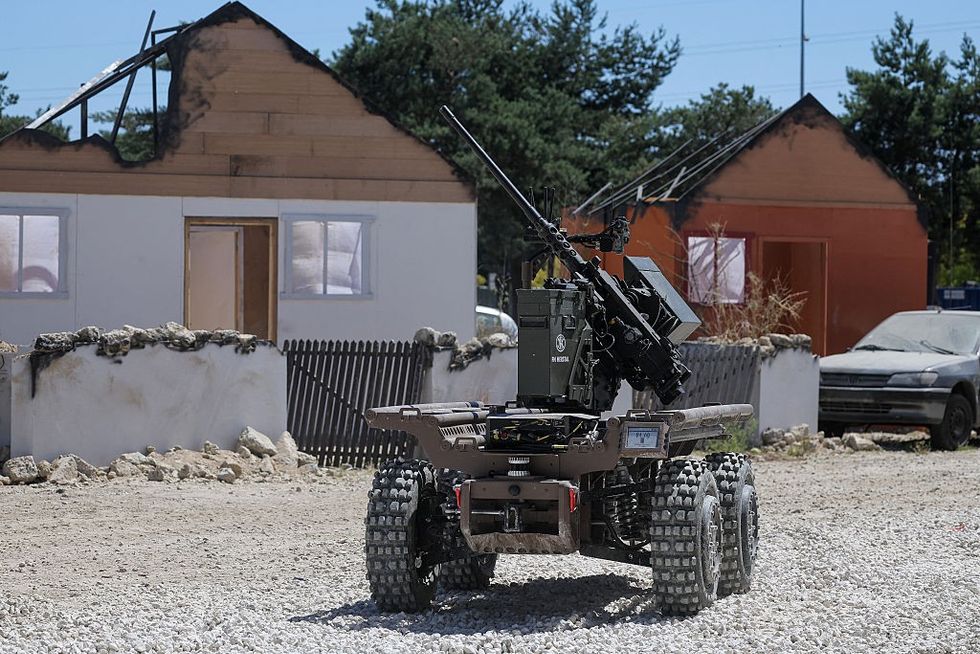

Ukraine’s ex-Protection Minister Mykhailo Fedorov, who led a warp-speed marketing campaign to carry an “Military of Drones” to the battlefield, has launched what he calls a “Manhattan Challenge” to construct an “Military of Robots.”
“The purpose of the Robotic Military is to save lots of human lives,” Fedorov mentioned in a latest presentation. “Robots ought to carry out essentially the most harmful work in order that our troopers return residence.”
“The principle query for 2027 just isn’t whether or not Ukraine could have a military of robots – it already does,” mentioned Morgan, the commander of a Particular Operations Group within the DIU (Protection Intelligence of Ukraine), who goes by his name identify.
“The query is how rapidly we will scale it up, and hand over to robots extra of the duties that individuals carry out as we speak on the danger of their very own lives.”
It’s a courageous new world of warfighting, and past its life-saving promise, it raises questions on non-human decision-making, and the way extensively and rapidly AI-guided robots will displace the world’s troopers.
“The premise must be that there shall be human management,” Lt. Gen. Jack Shanahan (Ret.), who served as the primary director of the Protection Division’s Joint Synthetic Intelligence Heart, advised The Cipher Transient.
“What we’ve to determine is the place, when and the way that management will get utilized. I don’t wish to see machines deciding…to do one thing that the people by no means anticipated.”
Main Yabchanka’s Journey
When Russia launched its full-scale invasion of Ukraine in 2022, Oleksandr Yabchanka was a fight medic; as we speak, he instructions an unmanned programs platoon for the “Da Vinci Wolves” battalion, and makes a speciality of what he calls “the robotization of fight processes.”
“The route a robotic covers as we speak is one that individuals would beforehand have needed to cowl,” Main Yabchanka advised The Cipher Transient. “In our situations, that will imply an especially excessive danger of being hit. Robots take that danger upon themselves.”
Practically each Ukrainian army unit now makes use of AI-guided robots, or UGVs (unmanned floor autos), for a spread of mundane however harmful duties. Yabchanka described a provide chain that begins with human troopers in rear positions who hand off ammunition, meals and different provides to UGVs for the proverbial final mile to the entrance. Robots restore cables and antennas, switch munitions, and assist armored autos which are caught within the mud. And more and more, they’ve been evacuating wounded troopers.
“This is likely one of the most tough operations, typically carried out underneath intense hearth,” Morgan, the Particular Operations commander, advised The Cipher Transient. “When robotic programs are used for evacuation, the danger is considerably lowered for service members who would in any other case must exit to assist their wounded comrades.” He believes that floor robots have already saved tens of 1000’s of lives.
“Think about having to hold a wounded particular person ten kilometers,” Main Yabchanka mentioned. “It takes a very long time, it’s bodily exhausting, and as soon as detected, the evacuation group turns into a precedence goal. We danger shedding each the wounded soldier and those that go to save lots of him. That’s the reason we hand this work over to UGVs.”
Ukraine’s Protection Ministry reported in September that UGVs had carried out 112,000 logistics and casualty-evacuation missions this 12 months.
“Lots of the (situations) are now not science fiction,” Main Yabchanka mentioned. “The query just isn’t a lot whether or not a military of robots is feasible, however how rapidly we will carry these applied sciences to the required stage of reliability, combine them into fight processes and guarantee their mass use.”
Robotic troopers that assume
The holy grail on this robotic evolution is full-scale offensive operations. Name that Mykhailo Fedorov’s dream.
For the second, battlefield selections are nonetheless made by people. These casualty evacuations are overseen by a human operator; and no giant “items” of robots have gone into battle alone.
However in small methods, Fedorov’s dream is already a actuality.
The New York Instances reported on a battle within the Kharkiv area that includes robotic autos which superior on a Russian place – “little inexperienced wagons” that “appeared like one thing you would possibly purchase at a backyard retailer to maneuver baggage of soil.” Every car carried 66 kilos of explosives, and as they neared the Russian troops, an aerial drone dropped a bomb and one of many robots blew itself up.
Two Russian troopers quickly emerged from a trench with an indication that learn “We wish to give up.”
In different phrases, a robot-led assault had resulted within the seize of Russian prisoners. “It’s higher to throw in metallic than folks,” Lt. Mykola Zinkevych, who commanded the assault, advised the Instances. “Human life is treasured, and robots don’t bleed.”
Extra just lately, in Ukraine’s Operation Vivaldi within the Donbas, UGVs have been dropped by aerial drones deep into Russian strains; the robots then attacked Russian positions. As considered one of Vivaldi’s commanders, who goes by “Darwin,” advised The Cipher Transient, his males would set up a protection line after which wait “till artillery, flying drones and robots do their work, after which go in once more.” Darwin mentioned his corps was the primary to reveal such coordination between autonomous and human parts.
David Kirichenko, an Affiliate Analysis Fellow on the Henry Jackson Society, mentioned Vivaldi had demonstrated “the inexorable erosion of the usefulness of people in direct contact with the enemy.”
In one other latest milestone, Ukraine’s “Lava” Unmanned Programs Regiment carried out what it mentioned was the world’s first fight logistics mission using an AI-driven floor robotic with out human supervision. The Protection Ministry mentioned its robotic navigated 93 % of a roughly 12-mile route; a human operator stepped in just for a one-mile stretch the place the terrain differed from what mapping software program had steered.
Fedorov’s “Manhattan Challenge,” which he unveiled at a convention in Lviv in late September, would take all this to scale – battalions of “humanoid robots” which are given a mission and are capable of modify techniques in mid-battle. Swarms of aerial drones have already proven this functionality; as Lt. Gen. Shanahan famous, “we’re speaking about drone swarms on the bottom versus within the air.” Fedorov says his “Military of Robots” is a logical evolution within the autonomous weapons area, and a solution to tackle Ukraine’s manpower scarcity.
“We wish to finally substitute our infantry with these robots,” he mentioned.
Fedorov’s plans are supported by a brand new consortium that features exterior buyers together with Palantir CEO Alex Karp. In a latest interview, Fedorov mentioned the venture had attracted greater than 800 functions from corporations, engineers, designers and programmers.
As with almost all army innovation in Ukraine, the “Military of Robots” time horizon is bold. Fedorov’s presentation included an preliminary six-month part culminating when a “humanoid robotic” kills its first Russian soldier; inside a 12 months, he mentioned, robots shall be able to conduct main coordinated assaults on their very own.
“We don’t have sufficient time,” Fedorov advised the Lviv convention. “We have to obtain these outcomes as quickly as potential.”
The Pentagon’s Push
Ukraine is now the widely-recognized international testing floor for brand spanking new army expertise, the house to what Cipher Transient knowledgeable and former CIA Director Gen. David Petraeus has referred to as “tomorrow’s expertise for as we speak’s wars.”
With this in thoughts, American producers have despatched prototypes of robotic troopers to Ukraine. In June, San Francisco-based Basis Future Industries mentioned it had dispatched its Phantom Mk1 robots to Ukraine for battlefield testing. Basis CEO Sankaet Pathak mentioned he was “satisfied the expertise is reaching a stage the place it could possibly substitute jobs which are harmful for people to carry out, and if you are able to do that, it’s the very best internet good you may create out of all functions of robotics.”
In the meantime, the U.S. and different nations are escalating efforts to spice up robotic capabilities inside their militaries. In late September, Protection Secretary Pete Hegseth introduced the creation of an Autonomous Warfare Command, and known as on all of the companies to speed up their autonomous and robotic capabilities.
“We are going to fuse procurement with operations at scale,” Hegseth mentioned, “and permit warfighters and engineers and entrepreneurs to be taught, adapt, and quickly iterate on their area.”
“What we’re starting to see with the usmilitary is an rising emphasis on autonomous programs on the bottom facet, the ocean facet and the air facet,” Lt. Gen. Shanahan mentioned. “I sense a palpable sense of urgency that I didn’t really feel a few years in the past.”
Consultants say the urgency is pushed by Ukraine’s successes in addition to the opportunity of battle with China. China is growing subtle army robotic programs of its personal, helped by an already-strong business robotics and electronics sector. Just lately China showcased quadrupedal floor robots, or “robotic wolves,” which consultants say are designed to cowl tough and mountainous terrain. Beijing’s broader army technique emphasizes “intelligentized warfare”; integrating AI, robotics, and information networks into fight operations.
Lt. Gen. Shanahan says such integration shall be important for the U.S. because it boosts its autonomous programs.
“Technically, it’s doable fairly rapidly,” Shanahan mentioned. “Organizationally, and the mixing piece of it, these are exhausting issues to work by way of.”
Dangers and limitations
Questions abound about the way forward for robotic armies – not least, their reliability, mobility and skill to react underneath hearth. “Humanoid robots” are costly, mechanically sophisticated and – for the second not less than – far much less subtle than typical floor autos and drones.
“You continue to have to take floor and maintain it to finish a warfare, and either side must agree the warfare is over,” Shanahan mentioned. “You may’t try this with drones on the bottom…Sooner or later you will want to finish up placing people on the bottom to carry floor or push again.”
Amongst sensible considerations, consultants listing communications, price and coordination.
An operator can not repeatedly management a robotic if the adversary jams its radio hyperlinks; Main Yabchanka has seen his UGVs incessantly disabled by Russian digital jamming. “For extra complicated autonomous features,” he mentioned, “increasingly computing has to occur on board the robotic system itself, with out relying on an exterior server or a steady communication hyperlink. This requires further computing energy, sensors and energy provide. All of this will increase price.”
By way of coordination, giant “items” of deployed robots should keep away from collisions, significantly in a dynamic battlefield. As with different AI-driven programs, consultants say repeated battlefield exams will assist iron out such issues.
Essentially the most profound questions contain the human ingredient. Will human beings stay answerable for missions as soon as they’re launched? Will robotic troopers establish potential targets? And can robots or people authorize engagement?
“We get so caught up in expertise itself, we neglect what a very powerful piece of it’s,” Shanahan mentioned. “How are you going to battle with it? What’s your working idea? What’s your organizational design, for bringing in all these floor programs? The place do you wish to put the people, the place do you wish to put the machines?”
Shanahan raised one particular nightmare state of affairs: a robotic unit that collectively “decides” that its mission is greatest served by hanging a civilian goal that no human has approved.
“You could possibly see this robotic on the market with agentic functionality, deciding that the quickest solution to finish the warfare is to not hit this factor that the human needs it to hit, however to hit that hospital over there as a result of the enemy will again down as soon as 500 civilians are killed in a hospital off the battlefield,” Shanahan mentioned. “That’s a disaster within the making.”
Even frontline commanders in Ukraine, who crave each technological edge they’ll get, share such considerations.
“Questions that when appeared like fiction at the moment are turning into totally sensible,” Main Yabchanka mentioned. “Right this moment, in a lot of the programs we work with, the choice to make use of deadly power stays with the operator. However expertise is already shifting towards some extent the place that call could possibly be handed over to a machine…We may find yourself in a scenario the place the choice to kill a human being step by step ceases to be a human choice. This can be a very harmful stage of technological growth, and humanity mustn’t rush towards it.”
Morgan, the particular operations commander, shares these considerations. However he additionally calls Ukraine’s AI-driven robots “considered one of our huge benefits over Russia.”
Yabchanka agrees. “Robotization is not only a brand new expertise,” he mentioned. “It’s our aggressive benefit and one of many important paths to victory over an enemy with far better manpower. This isn’t only a matter of technological progress. I’m satisfied that that is how we will win this warfare.”
The Cipher Transient is dedicated to publishing a spread of views on nationwide safety points submitted by deeply skilled nationwide safety professionals. Opinions expressed are these of the writer and don’t characterize the views or opinions of The Cipher Transient.
Have a perspective to share based mostly in your expertise within the nationwide safety discipline? Ship it to Editor@thecipherbrief.com for publication consideration.
Learn extra expert-driven nationwide safety insights, perspective and evaluation in The Cipher Transient
#Coming #Age #Robotic #Warfare #Cipher
Supply hyperlink
