

Brose accurately recognized a historical past of “change labels” within the final three many years with no ensuing or substantial adjustment to core navy strategies. This development started with the oncoming “navy technical revolution” in 1992, moved to Admiral Arthur Cebrowski’s “Community-Centric Warfare” within the mid-Nineties, Secretary Donald Rumsfeld’s “transformation” within the 9/11 period, and Deputy Secretary Robert Work’s “third offset technique” in 2014. Every introduced a slight twist on a typical theme: “…rising applied sciences will allow new battle networks of sensors and shooters to quickly speed up the method of detecting, concentrating on, and hanging threats.”
Brose didn’t cease there. He was crucial of American procurement selections during the last three many years as Washington “…poured cash into newer variations of outdated navy platforms and prayed for technological miracles to come back (which regularly grew to become acquisition debacles when these miracles didn’t materialize.” Brose was prescient in figuring out how cheap uncrewing might be – and the way a lot change it required of the navy mindset. Effectively earlier than Replicator (DOD’s main improvement program for autonomous autos) grew to become a glimmer in anybody’s eye, Brose recognized the necessity for fleets of drones, with ubiquitous communications and parts of autonomy.
To reiterate, this paper doesn’t intend to show and clarify the US’ reluctant acceptance of each aspect of this “drones, codes, and spacecraft” RMA. Actually, throughout our software of Marshall’s ideas, we cited three main developments that assist rule-out our reluctance to simply accept non-proximate warfare within the house and cyber domains: particularly, the institution of the United States Area Drive, USPACECOM, and USCYBERCOM. Drones are a distinct matter, although – and to show our reluctance, we are going to (a) examine the US’ charge of “navy drone fleet” improvement to that of Ukraine, and (b) display the stark distinction in DOD’s acquisition budgets between manned and unmanned property.
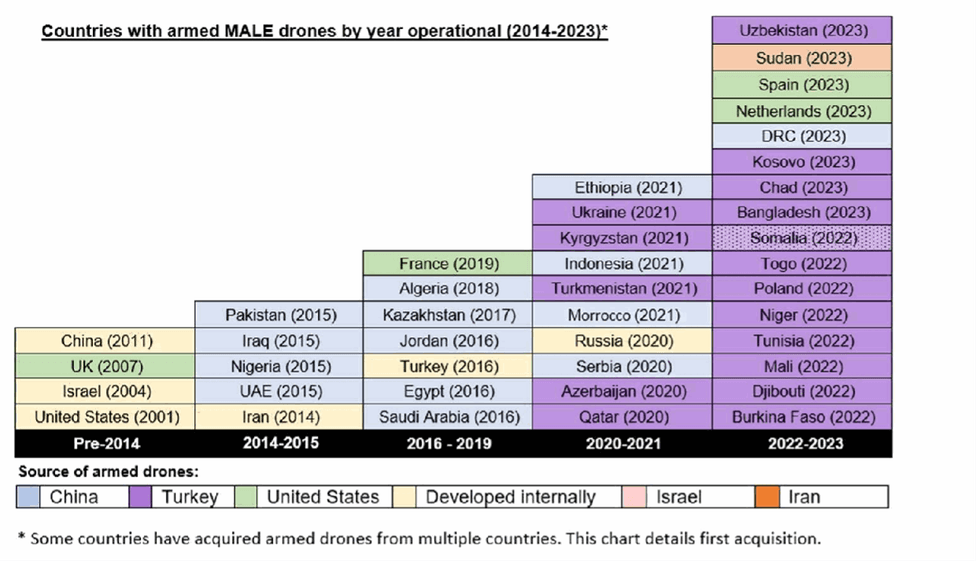
Globally, the variety of nations with armed drone applications has accelerated. The fast progress of armed, medium altitude, lengthy endurance (MALE) drones (such because the MQ-9 Reaper) since 2001 is clear on this graphic from Drone Wars UK:
Supply: Drone Wars UK
These giant, MALE drones are essential as a result of they will ship munitions prolonged distances and injury strategic targets resembling infrastructure and headquarters. Since Russia’s invasion in 2022, Ukraine has reworked itself right into a world chief of drone know-how and employment. Actually, Ukrainian President Zelensky simply introduced in December 2024 that his nation will produce 30,000 MALE drones subsequent 12 months. That almost triples DOD’s whole drone fleet of 11,000 (a quantity that even consists of smaller, non-MALE property such because the hand-launched RQ-11B Raven). The US’ manufacturing of navy drones has been lapped numerically by Ukraine in solely two years—regardless of America’s 20-year head-start in growing the know-how.
The Ukrainian Ministry of Protection Transformation studies seven drone fashions had been produced domestically in 2022, and that quantity has grown tenfold to 67 in solely two years. Equally, Ukraine now has an astounding 200 home drone producers. This stands in stark distinction to America’s drone manufacturing sector, which has declined. With the US’ withdrawal from Afghanistan and a discount in navy contracts, IBIS World estimates the US has solely 73 companies within the UAV manufacturing sector. As representationally depicted in Determine 3, the sector is declining at a Compound Annual Development Fee (CAGR) of 5.8 p.c to $4.0 billion by means of 2024 (dropping 21.4 p.c this 12 months alone.)
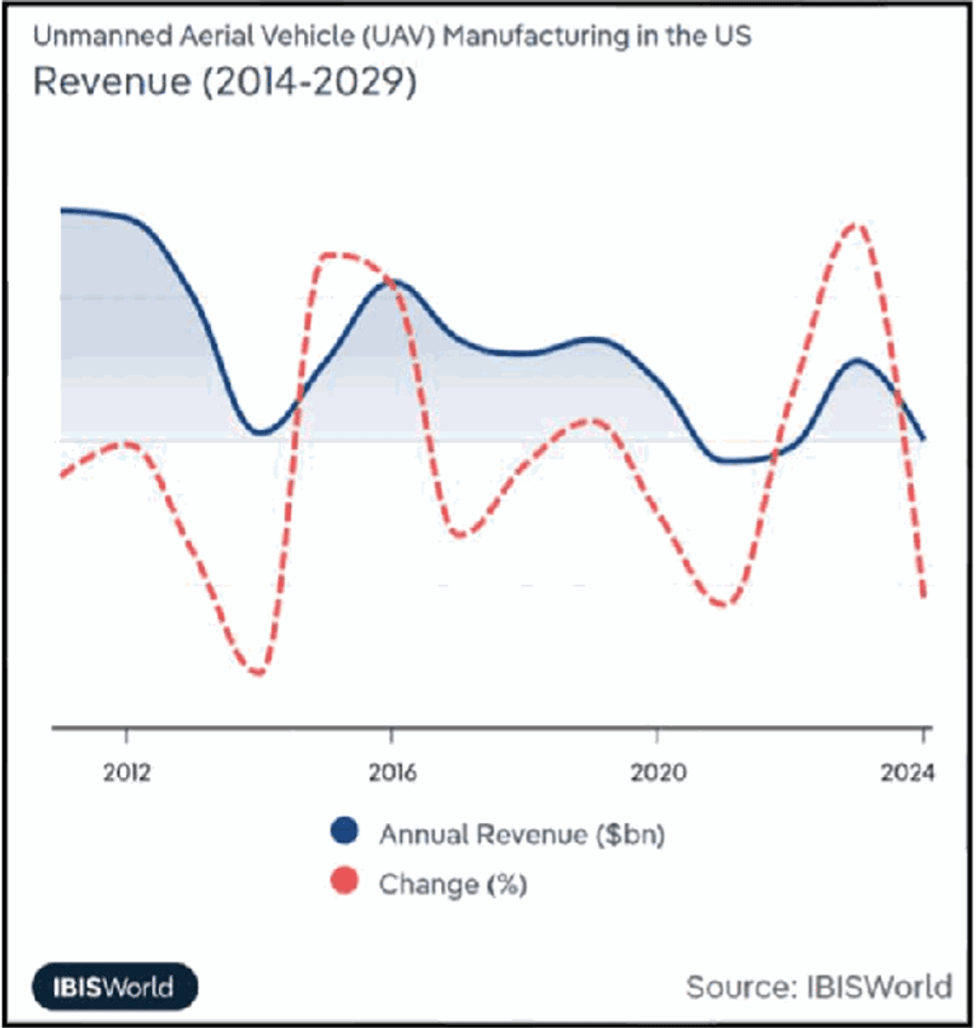
UAV Manufacturing within the U.S. — Supply: IBISWorld
In analyzing expenditures reported within the Workplace of the Below Secretary of Protection, Comptroller’s April 4, 2024 report, “Program Acquisition Value by Weapon System, FY2025,” the US’ reluctance to adopting the “drones” portion of this RMA is demonstrated additional. As depicted in Determine 4, unmanned plane programs account for lower than 4 p.c of DOD’s expenditures devoted to total aviation and associated programs. Individually, there are not any “unmanned” wedges in both the $48 billion of proposed expenditures for shipbuilding and maritime programs or the $13 billion or proposed expenditures for floor programs. To be truthful to the Navy, they do lead the opposite providers in Analysis and Growth for unmanned programs – however these investments would require time earlier than they’re made manifest within the fleet.
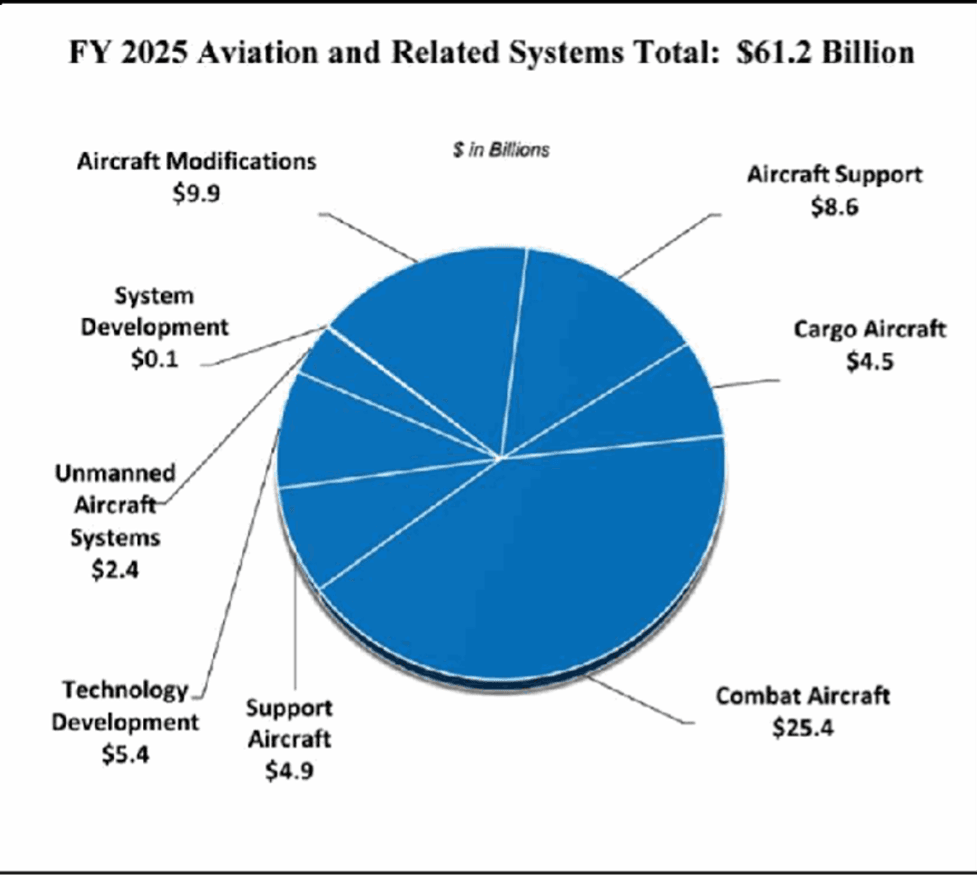
Determine 4: DOD’s FY2025 Aviation Expenditures — Supply: DOD Comptroller
Editorial word: This installment is drawn from the writer’s December 2024 white paper. Dates, figures, forecasts, and references to present occasions replicate that unique context.
Half Three of this sequence focuses on figuring out and testing our reluctance as this particular sequence continues all week in The Cipher Temporary.
Learn all 4 elements of the sequence solely in The Cipher Temporary this week and please word that the views expressed within the article are these of the writer and don’t essentially characterize the views or endorsement of factual accuracy of the Division of Struggle, the Division of the Navy, or the US.
The Cipher Temporary is dedicated to publishing a variety of views on nationwide safety points submitted by deeply skilled nationwide safety professionals. Opinions expressed are these of the writer and don’t characterize the views or opinions of The Cipher Temporary.
Have a perspective to share based mostly in your expertise within the nationwide safety discipline? Ship it to Editor@thecipherbrief.com for publication consideration.
Learn extra expert-driven nationwide safety insights, perspective and evaluation in The Cipher Temporary
#America #Invented #Drone #Struggle #Falling #Cipher
Supply hyperlink
