
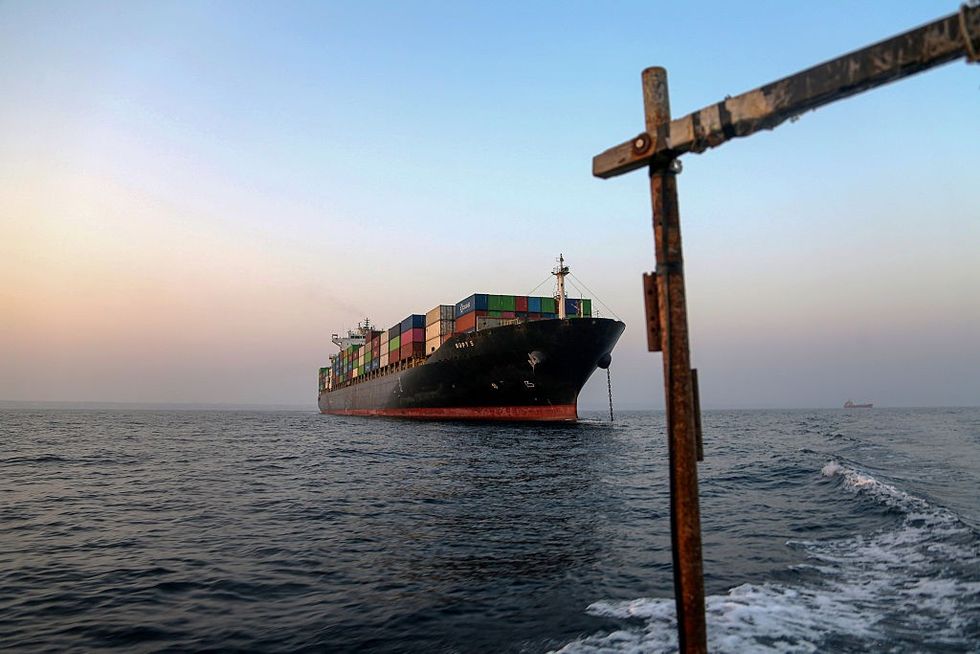

The Cipher Temporary spoke with Norm Roule, the previous U.S. nationwide intelligence supervisor for Iran, about how Tehran’s maritime cyber capabilities have advanced, what the most recent investigation might imply for business delivery, and whether or not the time period “grey zone” nonetheless captures the sorts of assaults governments and companies now face.
The Cipher Temporary: Ought to the most recent report of Iranian cyberattacks in opposition to worldwide delivery come as a shock?
Roule: The experiences are troubling, however the information gained’t shock policymakers or the delivery business. There’s a substantial physique of reporting on Iranian cyber threats to worldwide delivery courting again at the very least to 2019.
The Cipher Temporary: When did we first see proof of Iranian curiosity in operations to wreck or offensively manipulate ships?
Roule: First, we should always keep in mind that as not too long ago as August of this yr, the U.S. Coast Guard and Federal Bureau of Investigation have been investigating attainable Iranian involvement in cyber incidents affecting two power tankers, the VL Prosperity and the Kohaku, touring towards the United States. It’s laborious to not hear the echo of this earlier episode within the newest report.
There’s appreciable proof that Iran has built-in cyber and digital warfare capabilities into its maritime operations. In July 2019, the British-flagged Stena Impero and Liberian-flagged Mesdar reportedly skilled GPS interference earlier than being intercepted by Iranian forces. The U.S. Maritime Administration subsequently warned shippers within the area to count on GPS interference, bridge-to-bridge communications spoofing, or different malign communications jamming with little to no warning.
By 2020, Western cybersecurity specialists and intelligence sources recognized Iranian curiosity not merely in accumulating intelligence on business delivery however in growing the aptitude to inflict bodily harm on vessels. We then noticed reporting that documented Iranian focusing on of delivery corporations, port services, satellite tv for pc communications, logistics corporations, and industrial management methods.
In July 2021, Sky Information reported on leaked paperwork allegedly produced by Shahid Kaveh, an offensive cyber unit related to the Islamic Revolutionary Guard Corps (IRGC). The paperwork described Iranian curiosity in cyber operations in opposition to civilian infrastructure, vulnerabilities in maritime satellite tv for pc communications, and even the potential for sinking business vessels.
Later that yr, Microsoft’s Menace Intelligence Heart reported that an Iran-linked cyber group had focused greater than 250 organizations throughout a number of strategically essential sectors. Though fewer than 20 have been compromised, the goal listing was vital. It included Persian Gulf ports, worldwide maritime transportation corporations, cargo transportation companies, satellite tv for pc imagery suppliers, and American and Israeli protection corporations.
Microsoft assessed that the marketing campaign supported Iranian authorities efforts to observe adversary safety organizations and business delivery and to enhance Tehran’s contingency planning. Of explicit significance was the obvious Iranian curiosity in acquiring proprietary delivery data and business satellite tv for pc imagery.
The Cipher Temporary: Are you able to present examples of previous Iranian operations in opposition to maritime pursuits?
Roule: Cyber exercise assessed to originate with Iran focused Egyptian delivery and marine providers corporations starting in July 2022. In Might 2023, a possible Iranian actor focused Israeli business web sites, together with these of delivery and logistics corporations. The Egyptian case is especially noteworthy as a result of it illustrates that Iranian maritime intelligence pursuits weren’t confined to American or Israeli targets.
The Cipher Temporary: What motion has america taken in opposition to the Iranian officers accountable for growing these capabilities?
Roule: In February 2024, the U.S. Treasury Division sanctioned six senior officers of the IRGC Cyber-Digital Command for actions focusing on essential infrastructure in america and different international locations. Amongst these sanctioned was Hamid Reza Lashgarian, the identical particular person recognized within the 2021 Sky Information report as overseeing the Iranian cyber intelligence group related to analysis into maritime vulnerabilities. Treasury confirmed that Lashgarian headed the IRGC Cyber-Digital Command and was additionally a commander within the Qods Pressure.
The Cipher Temporary: Has Iranian delivery itself been the sufferer of serious cyberattacks?
Roule: I can consider a few instances, though there could also be others. In two main cyberattacks in 2025, the anti-regime hacktivist group Lab Dookhtegan, or “Sewn Lips,” claimed to have disrupted satellite tv for pc communications throughout greater than 100 vessels operated by Iran’s two largest state-linked delivery corporations.
The group reportedly compromised an Iranian telecommunications supplier, disrupting ship-to-shore communications and monitoring methods on vessels belonging to the Nationwide Iranian Tanker Firm and the Islamic Republic of Iran Delivery Strains. The primary operation, in March 2025, reportedly affected 116 Iranian vessels. A second operation in August reportedly affected 64 ships. Taken collectively, these incidents seem to signify among the most in depth cyber disruptions skilled by Iran’s maritime sector.
The Cipher Temporary: How has Iran’s maritime cyber program advanced, and why is it so essential to Tehran?
Roule: Iran’s maritime cyber actions seem to have advanced in phases. Tehran’s integration of cyber and digital warfare instruments into its regional maritime operations was evident by 2019. Iran subsequently elevated its concentrate on delivery corporations, port networks, satellite tv for pc communications, and logistics companies for intelligence assortment and wartime contingency planning.
If confirmed, the most recent suspected assaults in opposition to infrastructure and business vessels would present that Iran has moved to extra disruptive maritime capabilities as a part of a world coercion marketing campaign. Notably, Iranian focusing on has lengthy prolonged past American and Israeli pursuits.
As to why this system is so essential to Iran, Tehran has lengthy understood that its capacity to mission energy would rely closely on uneven instruments. Maritime cyber operations supply Tehran a way to avoid Western naval superiority and compensate for its lack of a blue-water navy or abroad army bases. On this approach, Iran can prolong its maritime coercion and affect over the worldwide financial system effectively past the Strait of Hormuz and Bab al-Mandeb.
Additionally, Iran doesn’t must sink a ship to realize a major strategic impact. The propaganda worth of even a failed assault could be substantial. It indicators Iranian intent and geographic attain whereas elevating questions in regards to the effectiveness of Western deterrence. Tehran seemingly calculates that, whether or not profitable or not, such operations can have financial penalties, together with larger maritime insurance coverage premiums, precautionary port closures, delivery delays, further vessel inspections, provide chain disruptions, and elevated expenditures on cybersecurity and maritime safety. Iran presumably hopes that these prices will translate into home financial and political strain on governments confronting Tehran.
The Cipher Temporary: May a cyberattack trigger a vessel to collide with a bridge, run aground, or undergo a catastrophic explosion?
Roule: Most consultants consider that is unlikely, however U.S. authorities authorities have explicitly recognized such eventualities as credible maritime safety dangers.
Following the 2024 incident in Baltimore that precipitated the collapse of a significant bridge, the U.S. authorities examined the potential penalties of cyber operations focusing on business vessels. Though the Baltimore incident itself was not a cyberattack, American authorities acknowledged {that a} profitable cyberattack in opposition to a big vessel’s operational expertise might probably produce comparable penalties.
Regardless of the nature of the incident, the implications of a cyber-induced catastrophe involving giant business vessels are profound, given the cargoes they carry and their proximity to main inhabitants facilities and significant infrastructure.
A big maritime cyber incident involving an power or chemical tanker might have monumental environmental, financial, and public security penalties. Close to a significant inhabitants middle, such an incident might additionally produce long-term public well being penalties. The broader financial and homeland safety implications would even be vital. Lastly, American and allied maritime infrastructure is important to U.S. army mobilization, sustainment, and abroad energy projection.
The Cipher Temporary: Are we doing sufficient to deal with this risk?
Roule: Seemingly not, however that doesn’t imply the scenario has been ignored. A lot of the emphasis to date has understandably been on bettering the cyber defenses of the delivery business and normal safety administration of associated structure.
There isn’t a public proof that Iran has efficiently carried out a harmful cyberattack in opposition to a business vessel on the excessive seas. It will nonetheless be imprudent to imagine that Tehran is not going to search to develop these capabilities or use synthetic intelligence to supply such instruments extra shortly.
We will additionally say that the worldwide group has not established credible deterrence in opposition to Iran and different international locations deploying these instruments. Sadly, sanctions alone is not going to be adequate to forestall their employment. A significant risk of army motion will seemingly be required.
The Cipher Temporary: What does Iran’s improvement of those capabilities inform us in regards to the altering nature of worldwide energy projection?
Roule: We’re watching the character of worldwide energy projection change in actual time.
Iran’s actions ought to reinforce considerations that the devices employed in regional conflicts will more and more be deployed globally, even when typical army operations stay geographically concentrated. The implications are profound. Iran is exhibiting that adversaries with restricted typical expeditionary army capabilities can probably threaten business infrastructure 1000’s of miles from their territory and impose excessive prices on adversaries possessing overwhelming typical army superiority.
Different adversaries are watching how this battle performs out. Center powers prepared to have interaction in such actions will more and more search to realize the form of strategic disruption beforehand related primarily with main army and intelligence powers.
This isn’t to counsel that typical army energy has misplaced its significance. Moderately, it’s to acknowledge that neither typical army superiority nor geographic distance offers the identical diploma of safety in opposition to hostile operations on one’s personal territory that it as soon as did.
The Cipher Temporary: Iran is hardly alone on this respect. How do its actions evaluate with what we’ve got seen from Russia?
Roule: Russia’s actions have been significantly consequential, and there may be little cause to consider that Tehran has not studied each the character of Russian operations and the worldwide response to them. Moscow has been blamed for a lot of cyber incidents, so I’ll solely cite a number of.
In 2022, a Russian cyberattack in opposition to the Viasat satellite tv for pc communications community disrupted communications and affected European wind power infrastructure. Since then, quite a few operations attributed to Moscow have sought to intrude with satellite tv for pc navigation methods supporting civilian aviation and maritime transportation. France additionally publicly attributed cyber operations in opposition to its pursuits to Russia in 2025.
These actions occurred alongside precise or suspected Russian exterior operations involving arson in opposition to a British warehouse containing tools destined for Ukraine, sabotage focusing on worldwide air freight networks, underwater telecommunications and power infrastructure, railway infrastructure, drone incidents affecting European airports, and assaults in opposition to business vessels within the Black Sea.
It’s tough to think about that Tehran has not taken word of the feeble worldwide response to those actions when contemplating its personal offensive cyber operations, threats in opposition to dissidents and journalists overseas, and provision of missile and drone expertise to the Houthis and different proxies.
The Cipher Temporary: Has Ukraine’s response to Russian aggression additionally demonstrated the altering geographic boundaries of warfare?
Roule: Ukraine is definitely not the ethical equal of Russia or Iran. However in its valiant struggle in opposition to Moscow, it has demonstrated {that a} center energy confronting a conventionally superior adversary can prolong the geographic scope of battle effectively past the principal theater of army operations.
The alleged Ukrainian involvement within the September 2022 destruction of the Nord Stream pipelines, the 2025 operations in opposition to Russian-linked vessels within the Black Sea and Mediterranean, and assaults in opposition to Russian offshore oil infrastructure illustrate the increasing geographic attain of the battle.
Newer Ukrainian drone operations, together with the November assault at Benghazi, Libya, on the Russian corvette Merkury, which sank, and the cargo vessel Angara, along with strikes on a Russian corvette and a Russian cargo ship within the Gulf of Finland, additional display the power of a rustic with restricted typical expeditionary capabilities to threaten its adversary’s pursuits throughout a number of theaters.
The strategic lesson is that international locations geographically distant from a battle could nonetheless discover themselves, their territorial waters, or their business infrastructure drawn into its battlespace with little discover. A battle which may as soon as have been considered regional can now generate safety penalties throughout a number of continents.
The Cipher Temporary: What do these developments inform us in regards to the altering nature of warfare?
Roule: We’re at a outstanding second in trendy army historical past, however we must be cautious about suggesting that we absolutely perceive the place these developments will lead. Nonetheless, sure traits are clear.
First, Iran’s actions within the Center East illustrate how trendy conflicts more and more unfold alongside an unpredictable, extended, and multi-theater continuum quite than by clearly outlined durations of warfare and peace. Hostile governments could regard themselves as engaged in a sustained confrontation even when Western governments contemplate themselves to be at peace. Espionage, affect operations, sabotage, intimidation, political interference, and even overt army operations can happen routinely, concurrently, and sometimes in plain sight.
Subsequent, the geographic boundaries of a battle have gotten more and more porous, making the normal distinction between the entrance line and the rear space much less significant. A warfare in Ukraine might result in sabotage in England, Germany, and the Baltic Sea. A battle involving Iran can generate assassination plots in america, cyberattacks in Europe, and threats in opposition to delivery in a number of oceans that undermine the economies of distant international locations. A future battle over Taiwan might contain the disruption of civilian infrastructure in continental North America.
Lastly, international locations that aren’t direct army contributors in a battle could nonetheless expertise its financial, safety, and bodily penalties with out with the ability to cease the aggressor from repeating its assaults.
The Cipher Temporary: How does this variation the safety calculations of governments and business enterprises?
Roule: A number of factors come to thoughts.
International locations are studying that defenders should defend an enormous community of services and business actions, whereas adversaries can focus their restricted assets on chosen goals. As shippers within the Gulf will seemingly agree, corporations are studying that safety by the worldwide group in opposition to open aggression is neither assured nor full.
Governments and companies should now acknowledge that comparatively cheap hostile operations can compel them to make substantial investments in safety, redundancy, intelligence assortment, and infrastructure safety. An adversary needn’t destroy a business facility to make its operation dearer, politically controversial, or commercially unattractive.
Industrial and civilian infrastructure will stay a strategic middle of gravity in future conflicts. The excellence between business safety and nationwide safety will change into more and more tough to maintain.
The Cipher Temporary: Is the time period “gray-zone battle” nonetheless enough to explain what we’re witnessing?
Roule: More and more, the terminology appears inadequate to convey the open depth of the actions being undertaken. Its continued use could even be softening perceptions of the violence concerned.
The phrase is helpful when describing coercive actions intentionally calibrated to keep away from typical warfare. Nonetheless, there may be nothing inherently grey about Iranian assaults in opposition to business delivery, drone assaults in opposition to vessels and airports, cyber operations meant to destroy civilian infrastructure, or terrorism carried out on the territory of one other nation.
Is that this terrorism? Warfare? What’s it? The excellence between wartime and peacetime has been eroding for years as intelligent aggressors exploit how the world has come to acknowledge and cope with aggression.
Russia, Iran, and China have demonstrated that geography, typical army inferiority, and the absence of an expeditionary army functionality not forestall a state from imposing excessive prices on distant adversaries or deterring vital retaliation. Their energy comes much less from their army power and extra from making essential financial arteries, business infrastructure, and the homeland itself operational theaters.
Sadly, the time period “grey zone” more and more describes the uncertainty, political hesitation, or diplomatic indecision of the defender quite than the character of the aggressor’s marketing campaign.
Contemplate Iran’s reported day by day assaults in opposition to civilian delivery within the Strait of Hormuz and the Persian Gulf. Not for the reason that Tanker Warfare of the Eighties, when Iran and Iraq attacked lots of of service provider ships, have civilian vessels from so many international locations, carrying cargoes so essential to the economies of so many others, been subjected to sustained assault by a state asserting authority over worldwide navigation that it has no respectable foundation to train. Greater than two dozen mariners have been killed and plenty of others injured. The useless embody residents of India, Thailand, and the Philippines.
The weak worldwide response isn’t an remoted case. Iranian and Houthi assaults in opposition to civilian targets throughout the previous decade elicited a equally restricted world response regardless of leaving useless and wounded from many international locations. A reported Iranian drone plot in opposition to a Royal Air Pressure base in England and disrupted terrorist operations in France and america have additionally failed to supply a publicly evident deterrent impact adequate to finish such actions, though a profitable assault might effectively have precipitated a number of casualties.
Whereas the boundaries to conducting such operations have declined, the brink for a direct typical and even unconventional response by the sufferer stays terribly excessive. This outstanding disparity offers an incredible benefit to adversaries. Policymakers have understandably been reluctant to determine agency pink traces which may constrain their freedom of motion. However within the absence of credible penalties, Iran and its proxies have little incentive to chorus from using these capabilities to their fullest extent, inserting the residents and business pursuits of quite a few international locations in danger.
The Cipher Temporary: Trying forward three to 5 years, the place are these traits more likely to take us?
Roule: Recognizing that my crystal ball isn’t any higher than that of any of your readers, it appears extremely seemingly that Western international locations will see extra frequent assaults in opposition to civilian infrastructure, higher geographic enlargement of regional conflicts, elevated state use of organized crime, and better structural prices for worldwide commerce. Geographic distance, neutrality, and the absence of direct army involvement in a battle will present diminishing safety in opposition to its penalties.
Russia, Iran, and different revisionist and aggressor international locations will more and more make use of felony intermediaries to conduct hostile operations, complicating attribution, counterintelligence, and diplomatic responses. Center powers, observing the strategic utility and comparatively restricted penalties related to these operations, will broaden their cyber, intelligence, unmanned methods, and covert-action capabilities. Repeated violations of territorial sovereignty with out significant penalties will additional erode worldwide norms, with significantly severe implications for smaller states.
The financial and home safety penalties might be substantial. Delivery, aviation, power, telecommunications, and monetary corporations will face elevated expenditures on bodily safety, cybersecurity, insurance coverage, infrastructure redundancy, regulatory compliance, and operational restoration. These prices will more and more represent a everlasting geopolitical danger premium quite than a brief wartime expense.
Industrial enterprises might be uncovered to geopolitical pressures stemming from the nationality of their homeowners, clients, cargoes, or buying and selling companions. Western governments will dedicate higher assets to counterintelligence, counterterrorism, infrastructure safety, and counter-drone capabilities, whereas requiring non-public business to imagine higher accountability for dangers traditionally considered issues of nationwide protection.
The Cipher Temporary: We’ve coated plenty of floor. How would you summarize the present scenario in closing?
Roule: The worldwide group is witnessing the accelerating evolution by which states more and more possess the means and willingness to conduct persistent and probably deadly operations in opposition to distant adversaries with out deploying typical army forces or declaring warfare. This capacity to mission disruptive and coercive energy is proliferating extra quickly than governments’ capacity or willingness to discourage its use.
Standard army superiority is not adequate to ensure territorial safety. Center powers, smaller states, and even non-state organizations have acquired devices able to imposing substantial financial and safety prices on a lot bigger powers. Wars will seemingly stay geographically concentrated, however their devices and penalties will change into more and more world. This dynamic inherently includes methods the imply civilian infrastructure and worldwide commerce might be more and more frequent components of interstate battle.
The principal hazard stays not that each hostile operation will trigger catastrophic harm. It’s that the worldwide system is more and more normalizing a degree of interstate violence and coercion that may beforehand have constituted a significant worldwide disaster and produced coalitions to confront aggressors and protect the worldwide order.
#Iranian #Maritime #Cyber #Menace #Altering #Nature #Worldwide #Battle #Cipher
Supply hyperlink
