

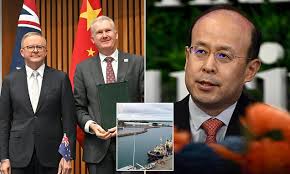
China’s ambassador to Australia has delivered a sharp warning to the federal government, cautioning that any attempt to reclaim control of a major northern port from Chinese ownership would provoke a response from Beijing. Ambassador Xiao Qian made the remarks as debate intensifies over the future of the Port of Darwin, a strategically significant facility leased to a Chinese company under a long-term agreement signed nearly a decade ago.
The comments add new strain to an already delicate relationship between Canberra and Beijing, coming at a time when both governments claim to be seeking stability after years of diplomatic tension. Australia’s Labor government has repeatedly signalled that it wants the port returned to Australian hands, citing national interest and security considerations, but has stopped short of announcing a concrete plan. Beijing, however, views the proposal as an unjustified interference in a lawful commercial agreement and a signal that Chinese investment is no longer welcome in critical Australian infrastructure.
Diplomatic Warning From Beijing
Speaking publicly, Xiao criticised what he described as growing political pressure on the Chinese firm holding the lease, warning that coercive measures would have serious consequences. He argued that forcing the company to divest would undermine trust and damage Australia’s reputation as a reliable destination for foreign investment.
According to the ambassador, Beijing would feel obligated to step in if the rights of Chinese businesses were threatened, framing the issue as a matter of principle rather than politics. He emphasised that the port operator had acted in good faith, investing heavily in infrastructure upgrades and improving the facility’s commercial performance over several years.
Xiao also suggested that reversing the lease now would amount to punishing success, noting that the port was far less profitable before Chinese investment revitalised operations.
The Port of Darwin and National Security Debate
The Port of Darwin sits at the centre of Australia’s north and plays a key role in trade, logistics and defence supply chains, making it a sensitive asset in regional security discussions. The 99-year lease to China’s Landbridge Group, signed in 2015, drew controversy from the outset, with critics warning of foreign control over strategic infrastructure.
Successive Australian governments have since faced pressure from security agencies and allies to reconsider the arrangement, particularly as geopolitical rivalry in the Indo-Pacific has intensified. Prime Minister Anthony Albanese has defended the government’s review of the lease, saying Australia must ensure that assets of national significance align with long-term strategic interests.
While the government has explored options such as finding an alternative buyer or negotiating new terms, officials have avoided detailing how a forced transfer might legally occur.
Economic Stakes and Trade Implications
China remains Australia’s largest trading partner, with billions of dollars in goods and services exchanged annually, making any escalation over the port economically risky. Xiao warned that uncertainty surrounding foreign investment rules could deter international capital well beyond the port dispute, affecting sectors unrelated to national security. He argued that governments must honour long-term contracts if they expect global investors to trust regulatory stability and political consistency.
Australian officials, meanwhile, insist that safeguarding national interests does not mean abandoning economic engagement, pointing to recent improvements in bilateral trade relations. Economists note that while a port dispute alone is unlikely to derail trade, it could contribute to a broader chill in business confidence if not carefully managed.
Strategic Rivalries and Allied Pressure
The Darwin port issue cannot be separated from wider strategic dynamics, particularly Australia’s deepening defence ties with the United States and other allies. Northern Australia has become increasingly important for military cooperation, with expanded troop rotations, joint exercises and infrastructure upgrades in recent years.
Beijing views these developments with suspicion, interpreting them as part of a containment strategy aimed at limiting China’s influence in the region. Some analysts argue that pressure to reclaim the port is partly driven by allied concerns, even if Australian officials publicly frame the issue as sovereign decision-making. This strategic context has amplified the symbolism of the port far beyond its commercial value, turning it into a proxy for larger geopolitical competition.
Domestic Political and Community Perspectives
Within Australia, opinions on the port remain divided, with some lawmakers calling for immediate action while others urge caution to avoid diplomatic fallout. Local business leaders have expressed concern about uncertainty surrounding the port’s future, warning that prolonged debate could disrupt trade and investment in the region.
Indigenous representatives and community groups have also sought greater involvement in discussions, arguing that decisions affecting the port should consider local economic and social impacts. Opposition parties have accused the government of moving too slowly, while supporters of the review say a careful approach is necessary to avoid legal challenges. The issue has become a test case for how Australia balances security concerns with economic openness in an increasingly contested global environment.
Legal and Contractual Challenges
Experts say any attempt to forcibly reclaim the lease would face significant legal hurdles, including potential compensation claims and international arbitration. The lease agreement was signed under Australian law, and unwinding it without mutual consent could expose the government to lengthy court battles.
Xiao pointed to these risks, arguing that unilateral action would set a troubling precedent for future infrastructure agreements. Australian officials have acknowledged the complexity, stressing that any move would need to comply with domestic legislation and international obligations. This legal uncertainty has contributed to the government’s reluctance to outline a clear timetable for resolving the issue.
Diplomatic Balancing Act
Despite the strong language from Beijing, both sides have publicly stated that they wish to avoid a major diplomatic confrontation. Australian ministers have reiterated their commitment to dialogue, saying disagreements should be handled through established diplomatic channels.
China, for its part, has framed its warning as defensive rather than confrontational, insisting it is merely protecting legitimate commercial interests. Observers note that both governments have incentives to keep tensions contained, particularly as economic ties recover from previous disputes. How Canberra proceeds on the port issue may ultimately signal the broader direction of Australia–China relations in the coming years.
Looking Ahead
The future of the Port of Darwin remains uncertain, with no final decision yet announced by the Australian government. What is clear is that the issue has become a focal point for debates about sovereignty, security and foreign investment. As regional competition intensifies, infrastructure assets like ports are likely to face greater scrutiny and political pressure.
For Beijing, the dispute represents a red line on the treatment of Chinese companies overseas. For Canberra, it is a complex test of whether national security priorities can be pursued without triggering serious diplomatic and economic consequences.
