

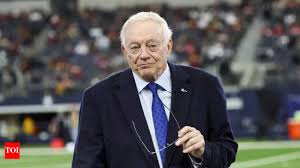
The Dallas Cowboys’ playoff hopes have dimmed dramatically after a critical loss to the Minnesota Vikings, leaving the team and its fans in disbelief. Cowboys owner Jerry Jones openly admitted that he did not anticipate the team being in such a difficult position with only three games remaining in the regular season.
Entering Sunday’s action, the Cowboys needed a perfect finish to their schedule combined with a faltering Philadelphia Eagles to have a realistic chance at claiming the NFC East title. A scenario in which the Cowboys would finish 10-6-1 and the Eagles 10-7 remained the only plausible route to the playoffs. Unfortunately for Dallas, that scenario quickly unraveled.
Hours before the Cowboys took the field, the Eagles dominated the Las Vegas Raiders 31-0, effectively increasing the pressure on Dallas. The Cowboys’ own performance fell short at home, as they fell to the Vikings 34-26 in a game that highlighted the team’s struggles on both offense and defense.
“We certainly didn’t think we’d be here in this kind of shape with three games to go and be behind the eight ball the way we are,” Jones admitted after the loss. “It’s very disappointing. I’m really, obviously, very disappointed for our fans. I’m disappointed for these players. I didn’t expect that. I thought we could come out here and on both sides of the ball make a better accounting of ourselves. Minnesota did the best job out there today on both sides of the ball.”
The Cowboys’ defeat has left the team on the outside looking in, though technically, they are not yet mathematically eliminated from playoff contention. Realistically, their chances of reaching the postseason are now considered virtually nonexistent. The team’s quarterback, Dak Prescott, acknowledged the reality of the situation, describing the loss as one of the most difficult of his career.
“It’s shitty,” Prescott said candidly after the game. His blunt assessment captured the frustration and disappointment felt throughout the locker room and the fan base alike.
This marks the second consecutive season that the Cowboys will likely miss the playoffs. Consecutive postseason absences are particularly bitter for a franchise with Dallas’ storied history and a roster filled with high-profile talent. The team’s struggles underscore systemic issues that have plagued them despite offseason acquisitions and high expectations.
Jones, reflecting on the challenging circumstances, noted the slim chances the Cowboys had from the start. “I don’t know how to describe a miracle,” he said. “I know it would take a very tight circumstance to get us in. We expected that. We thought we’d have to win out to have a little room, but not a lot. Now, of course, I know how to count.”
The Cowboys’ performance on both sides of the ball during the Vikings game illustrated why they are in their current predicament. Defensively, Dallas struggled to contain Minnesota’s offensive schemes, allowing critical third-down conversions and failing to stop big plays. On offense, the team could not consistently move the ball or capitalize on scoring opportunities, compounding their problems.
Special teams and turnovers also played a role in the loss. Mistakes in key moments contributed to momentum swings in favor of the Vikings, and the Cowboys were unable to respond effectively. Fans watching from home saw a team that appeared disjointed, lacking the cohesion and execution necessary to win crucial games down the stretch.
The loss has generated significant discussion among analysts and fans regarding the Cowboys’ decision-making and roster construction. Questions have emerged about coaching strategies, player performance, and the front office’s ability to assemble a team capable of competing at the highest level. Some point to injuries and inconsistent play at key positions as factors, while others cite deeper organizational challenges.
Despite the disappointment, Jones maintained a sense of responsibility and accountability. His public remarks underscored the stakes for both management and players, as the franchise navigates the aftermath of another missed opportunity. For Jones, the failure to meet expectations carries personal weight, given his decades-long stewardship of the team.
Looking forward, the Cowboys face a tough road. With three games remaining, each contest is now largely symbolic, serving as an opportunity for players to demonstrate resilience and build momentum for next season rather than a viable path to the playoffs. Coaches and team leaders must balance motivation with realism, focusing on development and evaluation while managing the morale of the locker room.
Fan reactions have been a mix of frustration, disappointment, and concern about the direction of the franchise. Social media platforms and sports forums have seen a surge of commentary criticizing performance, questioning personnel decisions, and reflecting on the team’s inability to capitalize on opportunities throughout the season. For a franchise with championship aspirations, this season has been a sobering reminder of how quickly circumstances can change in the NFL.
The Cowboys’ situation also highlights the competitive nature of the NFC East. Philadelphia’s dominance in recent weeks has shifted the balance of power, leaving Dallas and other contenders with limited flexibility. The margin for error is slim in the league, and even small lapses in execution can have outsized consequences, as evidenced by Dallas’ current standing.
As the season winds down, attention will likely turn toward evaluating personnel, potential coaching adjustments, and strategies for rebuilding a team capable of contending. The organization must weigh short-term corrections against long-term planning, particularly given the disappointment of missing consecutive playoffs.
Jones’ candid reflections provide a rare glimpse into the perspective of a franchise owner navigating challenging circumstances. His acknowledgment of the team’s struggles, coupled with his disappointment for fans and players, conveys the human dimension of high-stakes professional sports.
While this season may end in frustration, the Cowboys’ leadership faces the task of learning from setbacks and preparing for the next chapter. The road ahead will require careful decision-making, strategic acquisitions, and a commitment to fostering consistency and execution across all areas of the team.
For fans, the focus will shift to hope for the future and anticipation of offseason moves that could restore competitiveness. The Cowboys’ legacy, combined with the expectations that come with it, ensures that every loss is felt deeply. Yet, with the right adjustments, there is potential for redemption and a return to playoff contention in the coming seasons.
The Dallas Cowboys’ journey this season serves as a reminder of the NFL’s unforgiving nature, where even talented teams can find themselves in unexpectedly difficult situations. Jerry Jones’ reflections encapsulate the disappointment, reality, and the urgent need for the franchise to chart a path forward, emphasizing resilience and strategic planning in the face of adversity.
