
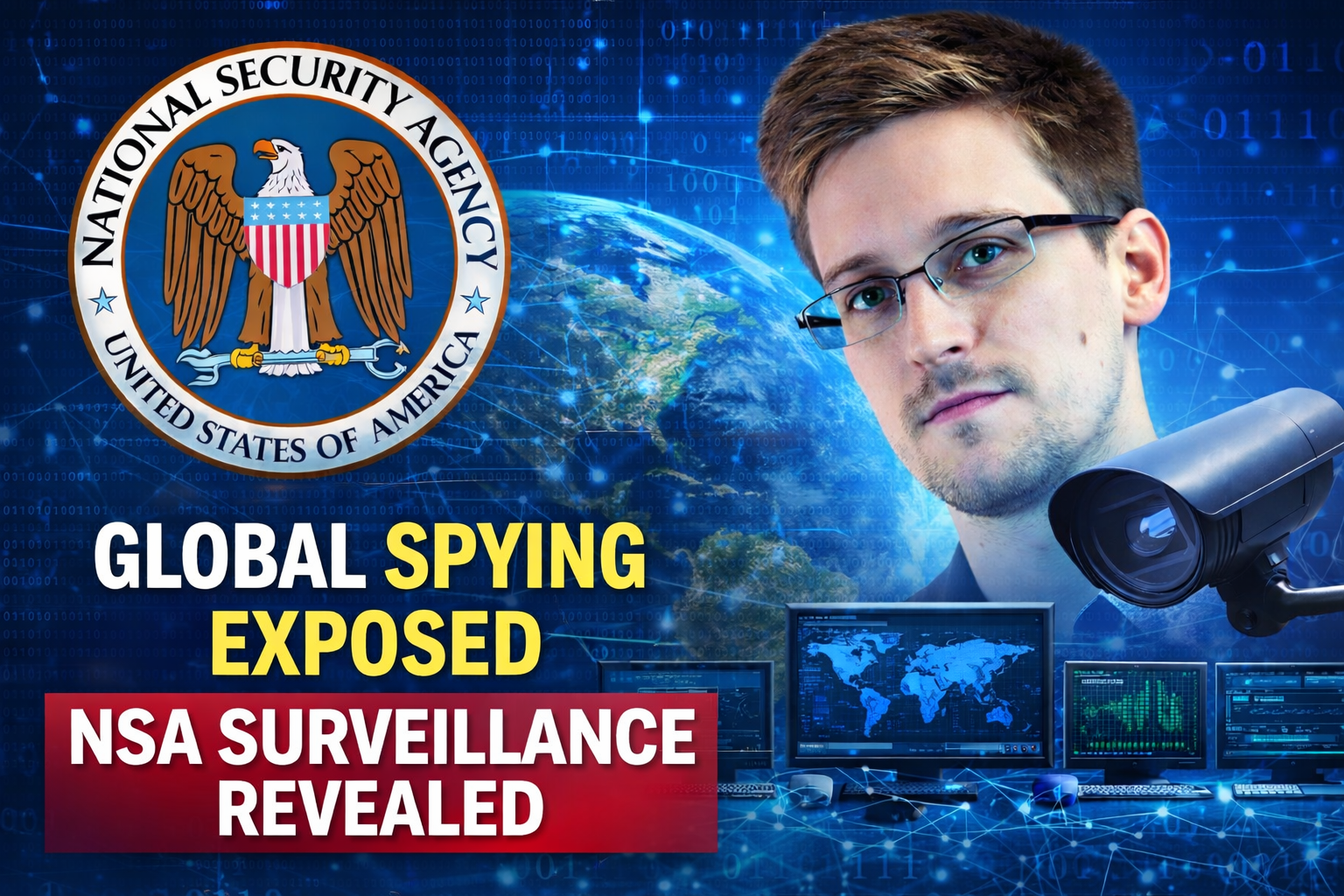

NSA Surveillance and the Expanding Global “Surveillance State”
Concerns about mass surveillance have intensified over the past decade, particularly following revelations linked to Edward Snowden.
“Detailed disclosures can be found via Edward Snowden reports: https://en.wikipedia.org/wiki/Edward_Snowden”.
Documents leaked by the former intelligence contractor exposed the vast scale of monitoring programs operated by the National Security Agency (NSA) and its international partners.
What many once dismissed as conspiracy theories is now supported by documented evidence, revealing just how deeply global surveillance systems are embedded in everyday digital life.
What many once dismissed as conspiracy has now been backed by documented evidence, revealing the true scale of modern surveillance.
These disclosures revealed how governments have increasingly relied on advanced technologies to track communications, raising serious questions about privacy, legality, and accountability in the digital age.
Read more in our World News section: https://foxtonnews.com/world-news/
A System Built on Mass Data Collection
Modern surveillance systems are designed to capture enormous volumes of data, often in real time. Intelligence agencies have developed tools capable of monitoring emails, phone calls, and internet activity across global networks.
While officials argue that such capabilities are essential for national security and counterterrorism, critics warn that these programs often extend far beyond their intended scope. In many cases, surveillance operations have included the collection of data from ordinary citizens with no direct link to criminal activity.
Privacy vs National Security
Following the September 11 attacks, surveillance programs expanded significantly, enabling large-scale data collection across global communication networks. Disclosures by Edward Snowden later revealed that intelligence agencies were capable of monitoring vast amounts of internet and phone data, often beyond publicly acknowledged limits.
The debate over surveillance largely centers on balancing individual privacy with the need to ensure public safety. Governments maintain that monitoring threats before they materialize is critical in preventing attacks.
However, privacy advocates argue that mass data collection undermines fundamental rights. They point out that broad surveillance powers can be misused, particularly when oversight mechanisms are weak or ineffective.
This tension has fueled ongoing legal and political battles in several countries, with courts and lawmakers attempting to define the limits of acceptable surveillance.
Global Surveillance Networks
The reach of modern surveillance extends well beyond national borders. Intelligence-sharing alliances between countries have created interconnected systems that allow agencies to exchange data on a massive scale.
Programs revealed in the Snowden documents suggested that multiple governments cooperated in monitoring global communications infrastructure, including undersea cables and major internet hubs.
This level of coordination has raised concerns about the erosion of sovereignty and the potential for widespread abuse of power.
Scale of Violations and Oversight Challenges
Internal audits and investigative reports have shown that surveillance systems are not immune to errors or misuse. In some cases, agencies have been found to violate their own rules, collecting or accessing data without proper authorization.
These incidents highlight the difficulty of managing complex surveillance frameworks while maintaining strict compliance with legal standards. Even with oversight bodies in place, ensuring accountability remains a significant challenge.
Explore more global updates on our homepage: https://foxtonnews.com/
The Role of Technology
Rapid advancements in technology have made surveillance more sophisticated and harder to detect. Artificial intelligence, data analytics, and machine learning now play a central role in processing vast datasets.
While these tools enhance the ability to identify potential threats, they also increase the risk of overreach. Automated systems can sometimes flag individuals incorrectly, leading to concerns about bias and wrongful targeting.
Public Reaction and Ongoing Debate
Public awareness of surveillance practices has grown significantly since the Snowden revelations. Advocacy groups, journalists, and civil society organizations have called for greater transparency and stronger protections for personal data.
Some governments have responded by introducing reforms aimed at improving oversight and limiting excessive data collection. However, critics argue that these measures often fall short of addressing the core issues.
Conclusion
The expansion of the global surveillance state reflects a complex intersection of technology, security, and civil liberties. While governments continue to emphasize the importance of intelligence gathering, the long-term implications for privacy and democracy remain uncertain.
“Detailed disclosures can be found via Edward Snowden reports: https://en.wikipedia.org/wiki/Edward_Snowden”
As surveillance capabilities continue to evolve, the line between national security and personal privacy is becoming increasingly blurred.
As digital technologies evolve, the challenge will be finding a balance that protects both national security and individual freedoms without compromising either.
👉 “Stay updated with our latest reports on international affairs.”
