

Police Comb Fire-Ravaged Hong Kong Apartments as Death Toll Climbs to 146
HONG KONG, Dec 1 (Foxto News) — Hong Kong authorities pressed on Monday with painstaking searches through the charred remains of multiple apartment towers devastated by last week’s massive blaze—an inferno that claimed at least 146 lives and forced hundreds more to confront the reality of sudden displacement and the uncertainty of life in temporary shelters.
The search operation, one of the largest mounted in the city in decades, has now accounted for four of the seven high-rise towers gutted in what officials describe as Hong Kong’s deadliest fire in more than three‑quarters of a century. Within stairwells, on rooftop escape routes, and in corridors clouded by soot, police teams have discovered bodies of residents who perished while attempting to flee the rapidly advancing flames.
The tragedy has shaken the city to its core, prompting tens of thousands of residents to assemble for somber vigils. On Sunday, mourners formed a queue stretching more than a kilometre along a canal bordering the ill-fated Wang Fuk Court complex, paying respects to the victims—among them at least nine Indonesian domestic workers and one Filipino helper whose lives ended far from home. Additional memorial gatherings are scheduled this week in Tokyo and London, underscoring the international resonance of the disaster and the global communities affected.
Authorities say approximately 40 individuals remain unaccounted for, their families anxiously awaiting updates as search teams work their way through the most badly compromised structures.
Investigators Probe Cause Amid Anger Over Safety Failures
The exact cause of the fire, which erupted last Wednesday and spread with explosive speed across the exterior of the buildings—then under renovation—has not yet been confirmed. What is clear is that the blaze raced across the façade with devastating efficiency, aided by construction materials that now fall under scrutiny.
Public frustration has intensified in recent days, with many residents pointing to previously ignored warnings about fire hazards, as well as allegations of unsafe construction techniques used around the estate. Anger has simmered particularly around reports that government departments had earlier downplayed residents’ safety concerns.
The political environment surrounding the disaster has also grown more tense. Beijing has warned against what it describes as attempts by “anti-China” elements to weaponize the tragedy for political dissent. According to sources familiar with the situation, at least one individual involved in circulating a petition calling for an independent inquiry has been detained.
Hong Kong police declined to provide details on the arrests, stating only that actions taken would be consistent with the law.
Search Efforts Shift to the Most Difficult Buildings
Senior police official Amy Lam addressed reporters on Sunday, explaining that the remaining towers yet to be combed are the most structurally compromised and dangerous. Lam noted that the final phase of the search could stretch on for weeks due to unstable flooring, collapsed corridors, and residual pockets of trapped water and debris.
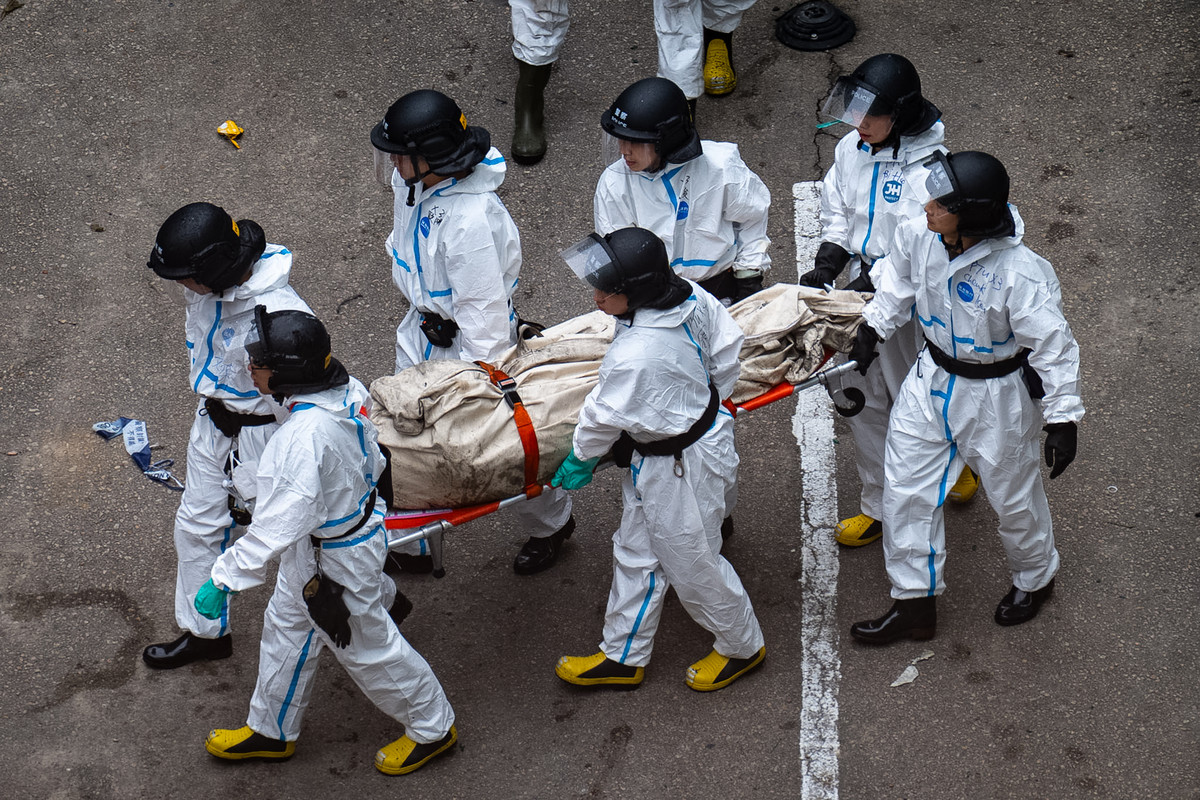
Images released by the police illustrate the enormity of the task: officers in full hazmat suits, masks, and protective helmets picking their way through apartments rendered nearly unrecognizable. Walls are blackened, entire rooms reduced to heaps of ash and melted metal, and knee‑deep water from the days-long firefighting efforts still fills many chambers.
At dawn on Monday, a new wave of officers descended on the complex to continue the laborious process, moving floor by floor through the burnt-out towers.
The estate had housed more than 4,000 residents, according to census data, and surviving families have begun the difficult journey of rebuilding their lives. Many fled with nothing more than the clothes on their backs, their homes and belongings either destroyed or inaccessible.
More than 1,100 individuals have already been transitioned from emergency evacuation centers to government-arranged temporary units. Another 680 people have been placed in youth hostels and hotels as authorities attempt to accommodate the sudden mass displacement.
To help affected households begin the long process of recovery, the government has pledged an emergency relief payment of HK$10,000 (US$1,284) per family. Special channels have also been set up to expedite the replacement of destroyed identity documents, passports, and marriage certificates.
Probe Deepens as Eleven Arrested Over Renovation Practices
The fire—Hong Kong’s deadliest since a warehouse blaze in 1948 that killed 176 people—has sent shockwaves through a city preparing for legislative elections later this week. In the aftermath, investigators broadened their inquiry into the renovation project underway at the time of the blaze.
Authorities have arrested 11 individuals in connection with potential corruption, misuse of materials, and construction malpractice. The building had been enveloped in bamboo scaffolding, green protective mesh, and layers of foam insulation—materials now under intense examination for possible flammability and failure to meet safety standards.
Compounding frustration among residents is the revelation that fire alarms in the complex were reportedly not functioning properly. Despite this, the Labour Department confirmed that residents were told last year that the estate carried “relatively low fire risks,” even after they expressed concerns about the renovation work.
A spokesperson further noted that in September 2024, residents had specifically raised alarms about the flammable nature of the mesh covering the scaffolding—concerns that now seem tragically prescient.
Arrests Linked to Petition Fuel Renewed Political Tensions
Among those detained over the weekend was Miles Kwan, a 24‑year‑old associated with a petition demanding an independent investigation into the fire, as well as a broader review of Hong Kong’s construction oversight mechanisms. Sources told reporters that while his detention was confirmed, it remains unclear whether formal charges have been filed.
Separately, two additional individuals were arrested on suspicion of “seditious intent,” according to the South China Morning Post. Police have declined to comment on any of the specific cases, reiterating only that ongoing investigations fall within the scope of Hong Kong’s legal framework.
Beijing’s national security office issued a sharp warning on Saturday, accusing unnamed actors of attempting to exploit the tragedy to destabilize the city—invoking echoes of the massive 2019 pro-democracy protests.
“We sternly warn the anti-China disruptors who attempt to ‘disrupt Hong Kong through disaster’,” the office declared. “No matter what methods you use, you will certainly be held accountable and strictly punished.”
The statement underscores the precarious political backdrop against which grieving families now navigate their loss, adding another layer of tension to a community already struggling with profound trauma.
Communities Unite Amid Grief and Uncertainty
Despite the fear, anger, and political unease surrounding the tragedy, Hong Kong’s community response has been one of overwhelming solidarity. Volunteers have been delivering meals, clothing, hygiene packs, and basic household items to those who lost everything in the fire. Counseling centers have extended hours, offering support to survivors experiencing shock, displacement, and survivor’s guilt.
Lines at donation points stretch down sidewalks, and social service groups report an outpouring of offers—from local families offering spare rooms to organizations coordinating toy drives for displaced children.
Religious groups across the city have opened their doors to host nightly vigils, while Buddhist temples and Christian churches continue to ring bells and hold prayer assemblies for the dead.
For many affected residents, the grief has become a collective experience, shared across neighborhoods and age groups. One elderly resident, who escaped the fire with her granddaughter, told local reporters that the kindness of strangers has given her “the only comfort” she has felt since the tragedy began.
A Long Road Ahead
As investigations continue, search teams brace for the grimmest phase of their work. The death toll of 146 may still rise as authorities work through the last of the structurally compromised towers, where temperatures from the blaze reached levels high enough to melt steel fixtures.
For survivors, the path forward remains uncertain. Temporary housing may stretch into months, and many families must rebuild their entire lives from scratch. Questions about accountability, safety lapses, and missed warnings loom large—questions that grieving families say they will not let fade.
For now, Hong Kong stands united in mourning and in quiet determination. While the scars from the fire will remain visible on the skyline for years, the emotional wounds—of loss, fear, and unanswered questions—may last much longer.
