

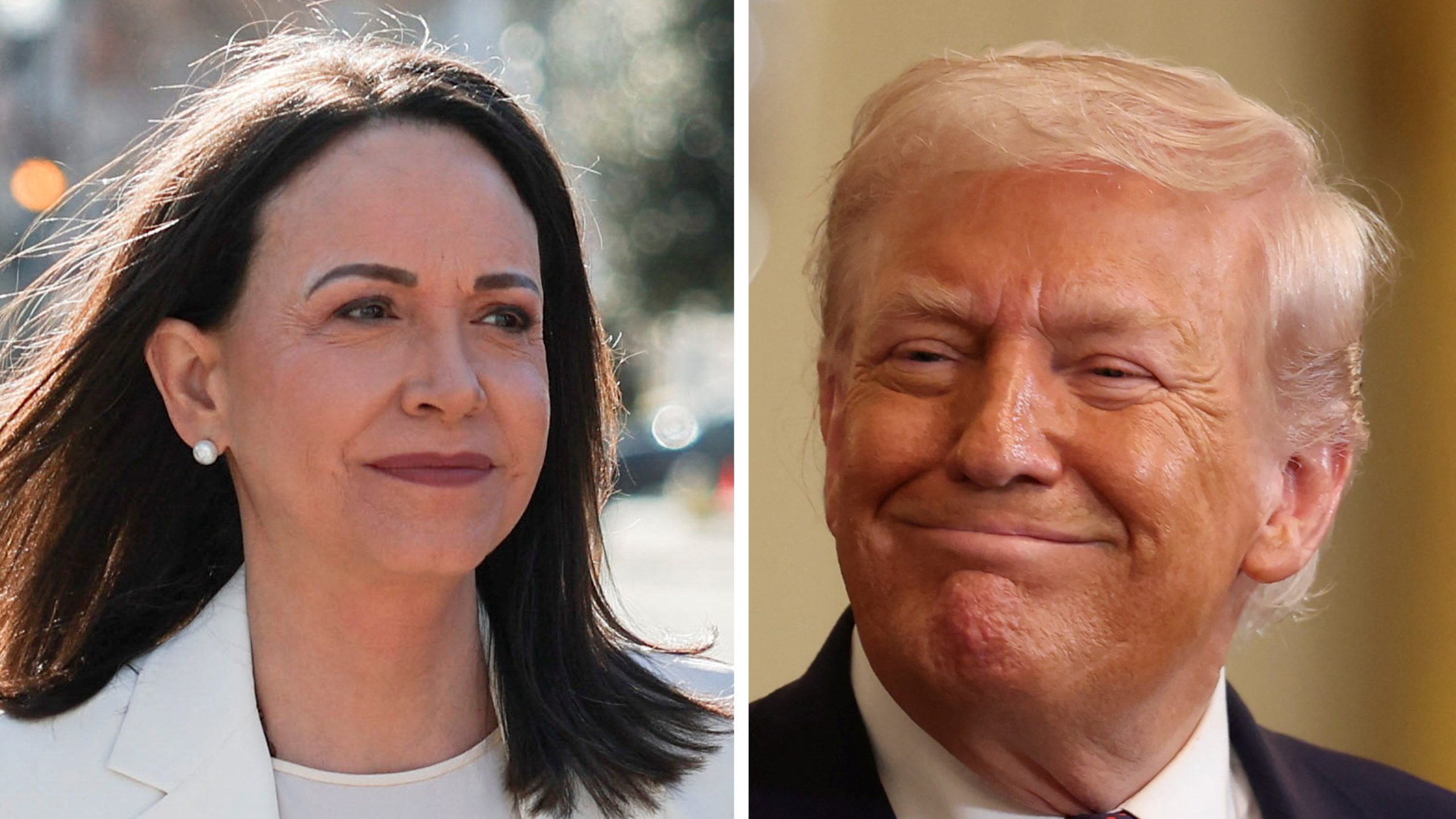
Venezuelan opposition leader María Corina Machado drew international attention this week after revealing that she had presented her Nobel Peace Prize medal to U.S. President Donald Trump during a private meeting in Washington. The announcement immediately sparked debate across diplomatic, political, and media circles. Many observers viewed the gesture as highly symbolic, while others questioned its political implications. Regardless of interpretation, the moment marked a rare intersection of global recognition and contemporary power politics.
Machado, who was awarded the Nobel Peace Prize in 2025 for her long-standing advocacy for democratic reform in Venezuela, described the act as deeply personal. She said the presentation of the medal was meant to honor what she believes to be Trump’s decisive role in confronting authoritarianism. According to Machado, the gesture represented gratitude rather than the transfer of any official status. Her remarks suggested that symbolism, not protocol, was the driving force behind her decision.
President Trump publicly acknowledged the presentation shortly afterward, expressing appreciation for what he described as a meaningful and respectful act. He framed the moment as recognition of shared values rather than a political endorsement. Images released by the White House showed the medal displayed in a formal setting, underscoring the ceremonial tone of the exchange. However, no formal statement outlined any policy changes tied to the event.
Officials familiar with the Nobel Peace Prize process were quick to clarify that the honor itself cannot be reassigned. While recipients may choose to display or gift their medals, the designation of laureate remains permanent and individual. This clarification did not diminish the symbolic weight of Machado’s action but helped contextualize it within established norms. The Nobel committee maintained its distance from the political conversation surrounding the presentation.
A Symbolic Gesture Amid Political Upheaval
The timing of Machado’s move is closely linked to recent upheaval in Venezuela, where the political landscape has shifted dramatically. Earlier this month, a U.S.-led operation resulted in the capture of long-time Venezuelan leader Nicolás Maduro. The event sent shockwaves through the region and raised expectations among opposition supporters. Many believed this could signal a new chapter for Venezuela’s future governance.
In the immediate aftermath, speculation surged about who might assume leadership during the transition period. Machado’s name surfaced repeatedly due to her international recognition and strong domestic following. However, Trump later signaled support for an alternative leadership arrangement involving figures from the existing political structure. This decision disappointed some opposition activists who had hoped for a cleaner break from the past.
Despite these developments, Machado has continued to frame her actions as part of a broader strategy to secure lasting democratic reform. She emphasized that symbolic gestures can play an important role in shaping international alliances. According to her, moral support from influential global leaders can help sustain momentum during uncertain transitions. Critics, however, argue that symbolism alone cannot substitute for concrete political outcomes.
Political analysts remain divided on whether the medal presentation strengthens or complicates Machado’s position. Some believe it reinforces her global profile and keeps Venezuela’s crisis in the international spotlight. Others warn that aligning too closely with a single foreign leader could limit her flexibility. The debate highlights the delicate balance opposition figures must strike on the world stage.
International Reactions and Diplomatic Implications
Reactions beyond Venezuela and the United States have been mixed but intense. Several Latin American leaders expressed caution, noting that internal political transitions should remain sovereign processes. European commentators focused on the unprecedented nature of a Nobel laureate using their medal in a diplomatic context. The move has prompted renewed discussion about how international awards intersect with real-world politics.
Within Venezuela, public response has been equally divided. Supporters praised Machado’s boldness and saw the act as a powerful appeal for international backing. Detractors accused her of prioritizing foreign validation over domestic unity. Social media platforms quickly became battlegrounds for competing narratives about the meaning of the gesture.
Machado addressed these criticisms directly during a public appearance outside the U.S. Capitol. She defended her decision by pointing to historical moments where symbolic acts helped galvanize global support for freedom movements. In her view, the medal was never meant to sit silently in a display case. Instead, she argued, it should serve as a tool to advance the cause for which it was awarded.
For his part, Trump refrained from making any immediate policy commitments regarding Venezuela. His comments focused on appreciation rather than action, leaving many questions unanswered. Analysts note that this ambiguity may be intentional, preserving diplomatic flexibility. It also underscores the limits of symbolism in influencing statecraft.
A Legacy Still Being Written
The presentation of the Nobel Peace Prize medal has ensured that Machado’s award will be remembered for more than its citation. Whether praised as visionary or criticized as controversial, the gesture has become part of her political legacy. It reflects a willingness to take unconventional steps in pursuit of democratic change. Such actions, while risky, often define transformational leaders.
As Venezuela continues to navigate a fragile and uncertain transition, Machado remains a central figure in the national conversation. Her supporters see her as a moral compass during turbulent times. Her critics question her tactics but acknowledge her influence. The coming months will likely determine whether her bold symbolism translates into tangible political gains.
The broader implications of this moment extend beyond Venezuela alone. It raises questions about how global honors can be leveraged in modern diplomacy. It also highlights the evolving relationship between personal conviction and international power. In an era of shifting alliances, such gestures carry both promise and peril.
Ultimately, María Corina Machado’s decision to present her Nobel Peace Prize medal to Donald Trump has added a dramatic chapter to an already complex political story. Whether it proves to be a turning point or a footnote remains to be seen. What is certain is that the world is watching closely. And for now, the conversation it sparked shows no sign of fading.
