

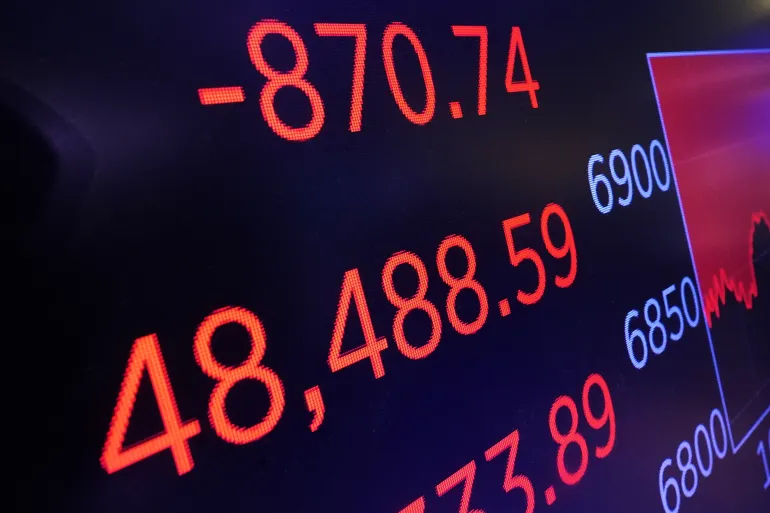
Global financial markets experienced a sharp downturn after United States President Donald Trump escalated his campaign to assert control over Greenland, triggering widespread investor anxiety.
The renewed push by the White House, framed as a national security necessity, rattled confidence as traders weighed the remembering implications for international stability. Trump has repeatedly argued that growing activity by Russia and China in the Arctic region requires a stronger American presence. His remarks were interpreted by markets as a signal of potential geopolitical confrontation rather than diplomatic negotiation.
In Washington, officials reinforced the president’s stance by suggesting that economic pressure could be applied to Denmark and other European partners if resistance continues. Such statements added to fears of a broader trade conflict at a time when global growth remains fragile. Investors reacted swiftly, pulling back from risk-heavy assets. The result was a wave of selling across multiple sectors.
Markets React to Rising Political Risk
Major US stock indexes suffered heavy losses as traders adjusted to the prospect of deepening international tensions. Shares in technology, manufacturing, and export-driven industries led the decline as concerns mounted over possible trade retaliation. Financial markets generally dislike uncertainty, and Trump’s comments injected exactly that into an already cautious environment. Analysts described the sell-off as a clear signal of investor unease rather than a correction driven by economic fundamentals.
The US dollar also weakened as confidence in American political stability took a hit. Typically seen as a safe-haven currency, the dollar instead fell as traders reassessed its short-term outlook. Currency strategists noted that political unpredictability can sometimes outweigh traditional safe-haven dynamics. As a result, several major currencies gained ground against the greenback.
European stock markets mirrored the downturn seen in the United States. Indexes across the continent closed lower as investors digested the possibility of strained transatlantic relations. Companies with strong exposure to US trade or defense contracts were particularly affected. The synchronized decline underscored how closely linked global markets have become.
Asian markets followed suit in early trading, with investors adopting a cautious stance. Losses were most visible in export-oriented economies sensitive to shifts in US policy. Although some indexes recovered slightly later in the session, sentiment remained fragile. Market participants appeared reluctant to commit fresh capital amid mounting geopolitical risks.
Diplomatic Fallout and European Response
Trump’s renewed focus on Greenland has placed unprecedented strain on relations between Washington and European capitals. Denmark has firmly rejected any suggestion that the territory could be sold or transferred. Officials in Copenhagen emphasized that Greenland’s status is a matter of self-determination and international law. European leaders have echoed this stance, warning that coercive tactics would undermine long-standing alliances.
The dispute has also raised concerns about the future of NATO unity. Greenland occupies a strategically important location, and tensions surrounding its status could complicate military cooperation. Several European officials privately expressed worry that public disagreements could weaken collective security arrangements. These concerns have prompted urgent diplomatic consultations behind closed doors.
Within the European Union, discussions have begun on possible responses if US pressure intensifies. While leaders stress that escalation is not their preferred path, they are preparing contingency plans. These include economic measures that could target specific sectors if relations deteriorate further. Officials insist any action would be coordinated to avoid internal divisions.
Strategic Stakes in the Arctic
At the heart of the dispute lies the Arctic’s growing strategic value. Melting ice has opened new shipping routes and access to natural resources, attracting global interest. Both Russia and China have expanded their presence in the region, heightening competition among major powers. The United States sees Greenland as a critical foothold in maintaining influence.
Security analysts note that while cooperation in the Arctic has historically been peaceful, that balance is beginning to shift. Increased militarization and competition could turn the region into a flashpoint. Trump’s blunt approach has amplified fears that diplomacy may give way to confrontation. Markets are reacting not only to current events but to the possibility of long-term instability.
For investors, the Greenland dispute is a reminder of how quickly political developments can disrupt economic expectations. Portfolio managers are increasingly factoring geopolitical risk into their strategies. Some have shifted assets toward traditionally defensive investments. Others are adopting a wait-and-see approach until clarity emerges.
As the situation continues to unfold, attention will remain focused on upcoming diplomatic meetings and official statements. Any sign of de-escalation could calm markets, while further hardline rhetoric may deepen volatility. For now, uncertainty dominates both financial trading floors and international diplomacy. The Greenland issue has moved beyond symbolism, becoming a real test of global political and economic resilience.
